It’s been quite a while since
I’ve heard those ‘three little words’ that sometimes bring a smile on my face.
Those words that were meant to ease the pain in a manner that would make even
the boring into something interesting. Those words that showed that there still
was a ray of hope in the world and that all relationships could last despite
partners being complete opposites.
Prepare. Attack. Destroy!
Remember them? For people across the globe they were just
‘words’ on an Adidas t-shirt, but for me those ‘words’ signified the prodigious
fusion between a certain Scottish goody and an American badass. I don’t know
when, how or why Adidas came up with the idea, but they sold it at the best possible
time as it summarized an amalgamation that to the tennis fraternity was the start
of something spectacular.
8-time Grand Slam winner Ivan Lendl joining forces with
Andy Murray was a match made in heaven it seemed. For a tennis player as bland
as Murray nothing is better than winning a Grand Slam (let alone the 17 that
Roger Federer has) and for the Scot to have the epitome of ambushing brilliance
on his side meant things had gotten serious in camp. So serious that “raw
aggression” seemed an understatement.
Almost immediately one could sense the changes in Murray’s
game. The intent to win every point was instilled. An aggressive approach to
the game was adapted. Those drop shots stated serving the purpose they were
destined to serve. Andy’s net-play that never was a major part of his game
suddenly became his “go-to” move. Perhaps for the first time ever Andy could
smell the glory of a Grand Slam success.
The world waited with baited breath as to what Lendl had
planned next. Every move was scrutinized. Every shot was analyzed. Murray
started getting the “oohs” and “aahhs” that differentiates the good from the
best. Lendl was clearly visible in Murray’s persona. “That shot had a Lendl tinge in it,” said the people. There was no
place for emotions. No more pain. No more crying. The path was set for the Andy
Murray bandwagon and it showed no signs of derailment. The dream reignited. A
knighthood loomed.
Not only under Ivan Lendl did Andy Murray reach the
Wimbledon final in 2012, but he also won an Olympic Gold Medal in London a
month later, won his first Grand Slam, the US Open title, the same year beating
Novak Djokovic in a gruesome 5-setter, reached the Australian Open final in
2013, where he gave a much better fight to Djokovic than the year before, and
ripped the Serb apart in straight sets later that year at Wimbledon to give
Great Britain a new song to sing ever since the “Oh hail Perry” anthem.

The term “first win since Fred Perry” started making an appearance more often than it did when the great Tim Henman was on the circuit. Great Britain could finally cheer for someone who could give something they’d waited for since forever. Ever since the lowest low in January 2010 when the words “I can cry like Roger, its shit that I can’t play like him” were muttered by a tear-faced Andy Murray amass the picturesque Rod Laver Arena, the world had been waiting for the prodigal son to bounce back.
The term “first win since Fred Perry” started making an appearance more often than it did when the great Tim Henman was on the circuit. Great Britain could finally cheer for someone who could give something they’d waited for since forever. Ever since the lowest low in January 2010 when the words “I can cry like Roger, its shit that I can’t play like him” were muttered by a tear-faced Andy Murray amass the picturesque Rod Laver Arena, the world had been waiting for the prodigal son to bounce back.
And now, the time had come! The only problem – it lasted
just two years.
In September 2013, Murray took probably the most treacherous
decision of his career when he decided to have back surgery. Although at that
time the Scot did not see the same as a career-threatening move, it did turn
out to have quite an impact on his career. Not physically, but mentally. His
comeback was not a fairytale one and unfortunately for British fans it was Ivan
Lendl who had to pay the price.
Since the inconceivable and intense final at the Flushing
Meadows against Djokovic in 2012 and the spanking finale against the same
opponent at SW19 a year later, all eyes had been on Murray to have an extravagant encore. However, ever since his
back surgery, Murray’s ranking tumbled from No. 2 to No. 9, his form was
nowhere near to his intimidating best and he was characterized as a player who
did not have a style of his own. To make things worse, he had to play consecutive
ATP 250s just to make the cut for the ATP World Tour Finals.
Needless to say, Lendl was on the first flight home,
which probably turned out to be the worst decision good ‘Ol Andy has made in
his entire life. Lendl’s departure was bigger a loss for Andy than any final he
ever played as it brought back the demons that not only took possession of
Murray’s feeble mind but also gave birth to a virus that infected the Scot’s game.
He started losing matches from winning positions. Fred Perry’s name seemed lost
in history now and Great Britain went into gloom again.

However, the one quality that Andy Murray has working for him is his will to not throw in the towel. Something that was clearly evident at the Australian Open this year. Apart from the fourth set in the final against Djokovic that saw the Serb fashion a blitzing bagel, Murray has been known to grind it out until the end of time. Before heading into Wimbledon 2014, the Scot got 2-time Grand Slam winner Amelie Mauresmo on board as her coach. A move that was probably aimed towards setting the records straight that Murray thought he still has a lot to offer when it came to top quality tennis.
Andy, of all people, knew that working with Mauresmo was
going to be looked upon with questioning eyes at all times. Yet, he still went
ahead with the move because he actually has a lot in common with the
Frenchwoman. Just like Murray, Mauresmo too had to spend her life being an
underdog and always having to cope with handling pressure. Mauresmo too has just
2 Grand Slams like Murray. And best of all Murray, just like Mauresmo, believes
that winning a match is about variety and not aggression.
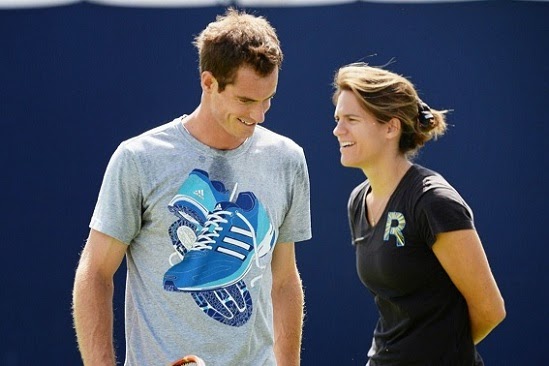
Such was the variety conjured by Mauresmo that even a pretty
one-dimensional Murray inculcated some wicked and acrimonious angles into his
game that left his opponents at the Australian Open fuming at the other end feeling
as if a brutal bruiser had stolen their lunch money. Melbourne was witness to
the new-old Murray when he demolished the likes of Grigor Dimitrov, Nick
Kyrgios and Tomas Berdych with scintillating artistry which was something even Lendl,
the man who for eternity will be attributed with turning Murray into a Grand Slam
champion, could not ingrain.
Andy Murray and Amelie Mauresmo also found common ground
on how to effectuate a strategy when it comes to finishing a tennis match. As
there are incalculable views on the subject in today’s power-driven era that
sees the gym-bred physicality rule the courts, Murray and Mauresmo are moving
forwards with a strategy that believes in quality, not quantity, and in keeping
things simple.

Now it is left to be seen whether or not that strategy
will work wonders for Murray, who at 28 does not have a lot of time in hand to
create a facade of being called a legend, or whether he can rediscover the
intensity and vigour that led him to the breakthrough US Open victory and the earth-shattering
Wimbledon triumph; however, at the end of the day what matters is that the
player and coach must have the same views on how to play the game.
Something that ‘Murreysmo’ has already mastered!

